Prove God
CanCanGod'sGod'sexistenceexistencereallyreallybebeproven?proven?
Do you think God exists?
"One does not find truth by skimming."
Our way of thinking has been influenced by these frameworks:
Empiricism
Excludes the supernatural on principle.
Relativism
Denies the existence of an absolute truth.
They are the pillars of a closed atheism, rejecting the idea of God on principle.
If a person adopts one of these two frameworks, no proof will ever suffice.
A challenge?
Click hereWhy did atheism prevail?
1. Two modes of thinking
The human mind operates through two main modes of thinking:
- Intuitive reasoning: fast, spontaneous, based on immediate evidence.
- Analytical reasoning: slow, methodical, and questions intuitions.
It is through this intuitive mode that we spontaneously come to believe certain self-evident things, such as:
- ✔ Universal morality (torturing for pleasure is wrong)
- ✔ The law of non-contradiction (a triangular square cannot exist)
- ✔ The idea of a creator (the universe appears to have been designed by an intelligence)
Even children with no religious upbringing develop these intuitions.
These intuitions are not meant to prove God's existence, but show that believing in Him is a natural predisposition of the human mind.
2. Cognitive colonialism
It is analytical thinking that ultimately prevailed at the cultural and historical level.
Consider two societies:
- Society A: maximizes analytical thinking.
- Society B: maximizes intuitive thinking.
Society A develops advanced technologies more rapidly (weapons, industry, medicine). Through this advantage, it ends up dominating Society B.
It then imposes its mode of thinking (empiricist & relativist) in schools, universities, and institutions.
3. The challenge of balance
Maximizing analytical thinking has enabled spectacular advances.
But used alone, it makes faith impossible.
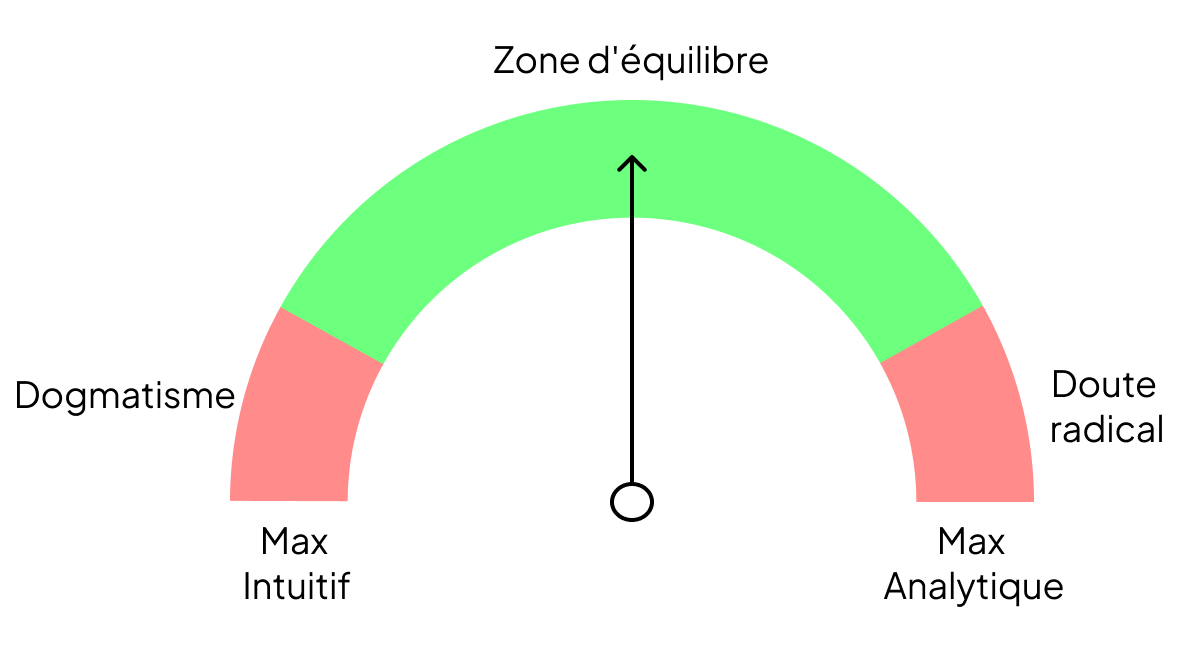
Take an artificial intelligence: it can analyze, compute, compare.
At best, it will say: «It is probable that God exists.»
But it cannot believe.
Why? Because it operates without intuition.
The real challenge is to seek this zone of balance.
Evolution ≠ Refutation of God
The theory of evolution is often misunderstood, which creates widespread confusion — starting with the very meaning of the word «evolution».
1. Observable facts
Variations in domestic pigeons, butterflies changing color… These are real phenomena, observed long before Darwin.
2. What Darwin proposed
Darwin generalized this observation. According to him, all species descend from a common ancestor, through a slow process filtered by natural selection.
3. The current model
Darwin knew nothing about genetics. His theory was updated in the 20th century to incorporate DNA and Mendel's laws. This is what we call neo-Darwinism.
This model rests on one central idea. Evolution results from random mutations, filtered by natural selection.
This is the model called "the theory of evolution".
4. The real problem
Science seeks natural causes, excluding God by method.
That is not a problem in itself.
The problem arises when one concludes that God does not exist... simply because science does not speak of Him. That is an intellectual trap.
Here is the implicit reasoning being offered:
1. A model is built (like neo-Darwinism) that works without God.
2. Then, one concludes that God does not exist… since the model works without Him.
Imagine a believer doing the reverse: he starts from the premise that God exists, builds a model that works with God, then concludes: «There — therefore God exists».
5. An incomplete theory
Furthermore, it must be noted that neo-Darwinism does not explain the origin of life. It assumes that a first cell appeared by chance, despite infinitesimally small odds.
Faced with this improbability, some imagine a «primordial soup». Others invoke extraterrestrials or bet on the existence of a multiverse.
Meanwhile, other scientific models envision an organization of life that relies neither on chance nor on statistical miracles.
6. The real question
If a theory is built without God, can it prove that God does not exist?
Further reading: The basics The death of neo-Darwinism
Counterarguments: What about the fossils?Observable macro-evolution?
Morality ≠ Refutation of God
Definitions:
Absolute morality : Valid at all times, in all places.
Objective morality : Independent of any human judgment.
Subjective morality : Influenced by our personal preferences.
The imperfection of man allows only a subjective morality.
The perfection of God guarantees a morality that is both absolute and objective.
& Absolue
Here are the two truly coherent positions:
1. God exists, and He is the source of what is right or wrong. Morality then rests on a foundation that is both absolute and objective.
2. God does not exist, no act is good or bad in itself. All that remains is a subjective morality. Hard to live with, but logically consistent.
There remains one last position: claiming an absolute and objective morality without God.
Even granting the existence of an absolute and objective morality without God, what happens if someone does wrong without being seen?
Nothing. No witness, no consequence. «If no one sees it, it doesn't count». No divine judgment.
A popular subjective attempt to ground morality without God is the famous «golden rule»: «Do not do unto others what you would not have them do unto you.»
But if I enjoy being hit, does that give me the right to hit others? No. Which is why an implicit condition is often added: consent.
However, a morality based on the golden rule and consent remains subjective and becomes incapable of condemning certain acts when no victim can be identified.
If we dislike an act, does that make it wrong?
Further reading: The challenge of morality without God Euthyphro Dilemma Presentism
Proof of God
Imagine an empiricist at the time of Moses : he would see the sea split in two... yet search for a natural explanation.
Or a relativist : «Perhaps my eyes are deceiving me» «It must be a very skilled illusionist».
The problem is not the absence of proof, but rather the question of what we accept as proof.
Here is a proof that God exists:
A challenge?
Send your challenge to: contact@prouverdieu.com
I believe that God exists
I know that God exists